Dear Dr. Snider,
The class on Diversity, Equity, and Social Justice has exponentially broaden my understanding of diversity and equity, and I am in disbelief on how narrow minded I was before taking this course!
I am also very grateful for being a lot more prepared to welcome 21st century children and their families.
Thank you for your class and words of encouragements!
MarieFrance
Monday, July 1, 2013

Saturday, June 29, 2013
Professionals Goals and Hopes
DIVERSITY

One of my hopes is to welcome children and
families from all diverse backgrounds in a way that feels comfortable and true
to them. In that light, I need to trust that my vision for a 21st
century school guides my passion, showing in the family reception, and marks
the start of a productive and warm relationship for the benefit of the child.
I hope that parents and educators teamwork
strive to offer children the most successful school experience and a future
that will have also be shaped by children with a voice.
EQUITY

In order to promote social justice and equity, schools must be accessible to all children from birth. With a universal school system, children from underprivileged families can be exposed to literature and receive similar intellectual and physical stimulation than their affluent peers whose parents give them access to books, music, movies, social and physical activities.
SOCIAL CHANGE - UNIVERSAL SCHOOL

To my wonderful colleagues Briana, Deanna,
Janet, Mahitab, Michelle, and Pearlyn,
Thanks to you, my sense of collegiality has
strengthened! Now, I feel empowered by the support you provided me throughout
these eight weeks and by the incredible insights you shared on early childhood education.
Your love and advocacy for our young population make me hopeful that from our
joint efforts a more just tomorrow for children is possible. Week 6 was
introduced with a quote by Robert Kennedy:
Each
time a person stands up for an ideal, or acts to improve the lot of others, or
strikes out against injustice, he sends forth a tiny ripple of hope, and
crossing each other from a million different centers of energy and daring,
these ripples build a current that can sweep down the mightiest walls of
oppression and resistance.—Robert F. Kennedy, U.S. Senator and Attorney General
(1968).
I hope we stay in touch via our blogs or
personal email addresses. Here is my email address:
We are too involved in our master’s program at
this point but when we graduate, I hope we can continue and develop our
relationships for children’s benefit, our own, and again children’s benefit.
Good luck on your next class!
Collegially,
MarieFrance
Friday, June 21, 2013
Welcoming Families From Around the World
YEMEN
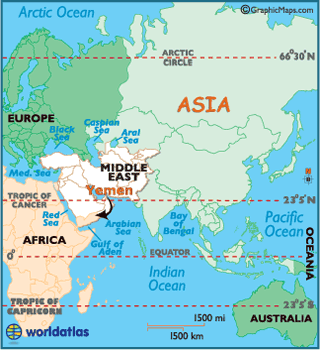
North and South Yemen united as
a country in 1990 to avoid fighting over oil that had been discovered along
their borders. Yemen’s capital is Sana’a (North Yemen) with the economic
capital referred to as Aden (South Yemen). Yemenis are ethnically Arabs and
they speak Arabic (Countries and their Cultures, 2013). People are mostly
farmers or herders. Then industry employs only 5% of the work force. Yemen has
a very young population with more than 50% under the age of 15.
Being a little savvier about
Yemen’s economic resources, I would ask the family from which of the 6 zones
they come from and what jobs they held. Did the mother work in education or in
health care as I read those were women’s jobs. Also, knowing from which
cultural and economic zone they family originates would give clues on the type
of house they lived in, their potential dialect, and cultural habits. When the
family comes in, I (a woman may initiate a handshake) would greet the family
with a light handshake and offer the choice to sit on the cushions along the
wall or at the table.
With the goal of preparing to
welcome a family from Yemen, I would feverishly uncover Yemen’s surface
culture, an easy way to start peeling off the different layers of what
constitutes a country’s culture. Music, food, and spirituality come to mind
right away. Then, I would learn what the custom is regarding greeting and
good-byes, and inquire on the education system in Yemen.

Song
of Sana'a
"The
"Song of Sana’a" was
proclaimed a Masterpiece of the Oral and Intangible Heritage of Humanity by the
Director-General on 7 November 2003. A preparatoryassistance of US$ 20,000 was
granted to the Permanent Delegation of Yemen by theUNESCO/Japan Funds-in-Trust
for the Preservation and Promotion of Intangible Cultural Heritage in view of
establishing a candidature file and an action plan (UNESCO, 2011)
Reference
UNESCO.
(2011). Key Facts and Figures on Yemen/UNESCO Cooperation. Retrieved from: http://www.unesco.org/eri/cp/factsheets/YEM_facts_figures.pdf
Yemenite
Sacred Chants
http://www.allmusic.com/album/les-chantres-yemenites-sacred-songs-from-sanaa-mw0000588342Sample her songs on the following website
http://www.allmusic.com/album/yemenite-songs-mw0000196994
"Ofra Haza's death on February 23, 2000, at the age of 41 deprived the world of a lovely woman, a great vocalist, and a fearless cultural advocate. Fifty Gates of Wisdom, her 1985 album of boldly reimagined traditional Yemenite songs, brought her international fame, and decades later, it retains its ability to delight and inspire. The set list consists of secular tunes plus examples of a festive devotional style called diwan, which is common to all Oriental Jewish communities and can be sung in Hebrew, Aramaic, or Arabic. Each group has specific traditions, but the Yemeni variant is especially remarkable for its poetry, much of which was written by rabbis as far back as the 17th century. Most diwan consist of three separate sections: the a cappella nashid (prelude), the shira (singing), during which celebrants bang on copper trays, empty gasoline cans, or whatever else is handy, and a postlude called the hallel, or song of praise. The unusual percussion accompaniment came into use following the destruction of the Temple, when Jews were forbidden to play conventional musical instruments, and also as a result of periodic oppression by Muslim fundamentalists. In Haza's hands, these sinuous tunes are further spiced up by drum machines and synthesizers, pumping out the hypnotic dance beats that catapulted the album onto dancefloors throughout the world. It important to remember that this recording long predated the flood of world/techno fusions that have since overwhelmed the marketplace. Transglobal Underground, Afro-Celt Sound System, and Scandinavian groups like Garmarna all owe Haza a debt of gratitude. But despite the historic electronic flourishes, it is the siren-like charm of the singer's voice that creates the most indelible impression" (allmusic, 2013).
Reference
allmusic. (2013). Ofra Haza. Yemenite Songs. Overview. Retrieved from: http://www.allmusic.com/album/yemenite-songs-mw0000196994
Continuing with food, the following blog written by Dr. Lamya Almas was a lot of fun perusing because it offers an amazing array of Yemeni recipes mostly inspired by the blogger’s mother: http://yemeniyah.com/about/. Since I love Middle Eastern food, I may even scout out for a local Yemenite restaurant and try out my newly acquired knowledge about Yemeni food and ask for a Mutabaqiah Yemeni which is a sort of egg calzone. Lentils, peas, and rice are staple foods. Since generosity and hospitality are shown by making and serving coffee, I will make sure to have coffee and learn how to make it in a satisfactory traditional way.
After
learning about music and food, I learned that Yemen’s main religion is Islam.
There are two main groups of Muslims namely Sunni and Shi’a. I expect that the
new family is Muslim, although they could also belong to one of the smaller
Jewish, Christian, or Hindu groups.
Developing more familiarity with the country of Yemen will help me show the family that I am ready to work collaboratively so their children succeed in school. Since their children will bring their home culture to class and go home with the newly created class culture, it is important that parents and educators support children in their “creative transformation of culture” (Smidt, 2006). In the initial contact with the family, carefully listening to the family’s story will bring invaluable information on how to best serve the child. After the initial conversation, learning about the family’s cultural approach on education, asking them if they know about the U.S. educational system, what they like or what simply would not be appropriate for their children. As the educator, knowing how I can best support children in their learning and acknowledge students’ accomplishments even if they differ from the school dominant culture (Smidt, 2006). In other words, I will inquire about the “physical and social settings of children, the culturally regulated customs and practices, and beliefs or ethno-theories of parents” (Smidt, 2006). Finally, children’s cultures define my curriculum.
References
Countries and Their Cultures. (2013).Yemen. Retrieved from: http://www.everyculture.com/To-Z/Yemen.html
Smidt, S., (2006). The Developing Child in the 21 st. Century: A Global Perspective on Child Development. Routledge.
Saturday, June 15, 2013
The Personal Side of Bias, Prejudice, and Oppression

When my older sister’s fiancé visited her at home, it was not
unusual for the two of us to play. He would take on the role of big brother
playing with his younger brother. Then, I grew up and was not enticed to play
like a boy anymore. Having lost a playmate, I understood that my sister’s
fiancé could be disappointed. However, the way he expressed his disappointment
made me feel that he had lost any interest in me and that I had become
invisible because I was a girl. This is what he said or what I remember him
saying “It’s too bad that I can’t play with Marie anymore the way I did before
when I could play with her like a boy.” This gender microaggression exemplifies
an institutional prejudice toward girls/women: girls/women measure less than
boys/men, and boys/men represent the valuable segment of society. A little
later, the same young man not liking the cleanliness of the bathroom exclaimed
“With three girls in the house, how can the bathroom not be clean?” Thanks to
my future brother in law, my future was clearly outlined and I had better start
right learning the ropes of a perfect house wife. Unfortunately, each incident struck
me with full force and I was unable to turn them into opportunities for greater
equity. It is only after turning forty
that I started to empower myself and whenever I felt strong enough attempted to
change incidents of that sort into teaching moments for equity. For example,
one of my daughter’s friends whose family enjoyed the help of a hired woman
remarked one day as I was cleaning behind the kitchen sink tap “You are finally
cleaning this” and I assured him that he could feel free to take care of this
whenever he felt like it. Not highlighting the young man’s rudeness and
offering him to notice his prejudice provided a better teaching opportunity.

Another example of
institutional prejudice can be found in the movie “Men of Honor” (2000) where
Carl Brashear, an African-American, dreams to become a Master Chief Navy
Diver. Brashear is confronted with
racism and has to overcome many hardships and obstacles. As I was looking for information on the movie
and the book written by David Robbins, I came upon a TV review raising a doubt
about the main character’s integrity, therefore invalidating the purpose of the
movie which to my understanding was to increase awareness on an American coming
from a minority group whose dedication to his country and his courage would take
him against all odds to the top level of his military career. Here is the quote from Simels’ review in
TVGuide:
“Heroes are hard to
find, so it feels churlish to carp about a film that tells the true story of
sailor Carl Brashear (Cuba Gooding Jr.), who overcame systemic racism to become
the U.S. Navy's first African-American deep-sea diver. On the other hand, it's
a little odd that nobody involved — certainly not screenwriter Scott Marshall
Smith or director George Tillman Jr. — seems to have noticed that it's also the
story of a guy who literally cut off a limb to achieve a career goal. No
disrespect to the real-life Brashear intended, but reasonable viewers might see
this act as more masochistic and creepy than uplifting (Simels, n.a.)”
Interestingly, this
article weaves biases and prejudices with positive comments and succeeds in creating
a doubt in readers’ mind as to Brashear’s actual intention and the validity of
his racial struggle.
|
|||
Saturday, June 1, 2013
Practicing Awareness of Microaggressions

Surely providing students with a safe environment means
teaching them what to do and when to do things. There exists a fine line
between teaching guidelines and imposing power over them. In a combined first
and second class this week, a female first grader was subjected to the microaggression
of a female second grader. Although this interaction involved two young girls,
the issue at stake involving power puts weight in the scale of gender
microaggression.
At the end of class, the teacher calls students one by one and
asks them to get up, push in their chairs, and get in line, all in the target language.
Most of the children are in line and the teacher calls the third to last student,
a first grade girl. After giving her instructions to this student, the teacher
directs her attention to a student who was engaging a conversation with a peer.
Then, the teacher hearing “Yes, the teacher told me” and seeing that the
student whom she had asked to get in line was standing in the middle of the classroom
asked what the problem was. The first grade student answered that a (second
grade) peer was saying that the teacher had not asked her to get in line and
that she was not following instructions. The teacher confirmed that she had given
her permission to join the line. Once in line, the teacher asked the first grader
if the teacher had given instructions to get in line and the first grader
acquiesced. The teacher continued and asked the student if she was doing the
right thing by getting in line, and she replied yes. Then, the teacher encouraged
her to continue to do what she was doing if she knew she was doing what she was
supposed to and not give up her position of power.

Since the second grader had engaged in a power struggle with
the first grader, the teacher needed the situation so the microaggression could
be turned into a positive outcome. Rather than focusing on the second grader’s
point of view, the teacher chose to help the first grader empower herself when she
knows she is doing the right thing, not give up her rights, and stand tall.
Was it appropriate to disregard the second grader’s behavior
in that case and risk making the student feel dismissed in what she thought was
right? Since the second grader took upon her to take a leader’s role and boss
her classmate, the teacher not paying attention to her attempt of gaining power
stopped the student’s behavior. Also, not giving the second grader any
attention turned the focus back on the first grader who was doing the right
thing, and allowed her to feel proud of herself.
Microaggressions can take many forms namely racial, gender discrimination, sexual orientation, and are frequently unconscious and unintentional. However, those unconscious and unintentional microaggressionss are the most damaging. In this light, it is important to learn to recognize microaggressions in school and address them immediately. Teaching children how to empower themselves may palliate a future where they will have to deal with discrimination, prejudice and stereotypes.
Reference
Laureate Education, Inc. (Producer). (2011). Microaggressions
in Everyday Life [Video webcast]. Retrieved
from https://class.waldenu.edu/Saturday, May 25, 2013
Perspectives on Diversity and Culture
Before
taking the class on “Culture, Diversity & Equity", my definition of
culture and diversity would have been short because I would not have dared or
thought to include the many influences listed in chapter one of Gonzalez-Mena’s
book Diversity in Early Care and
Education (2008):
“Race
Gender
Age
Abilities and disabilities
Language
Social class including status and economic level
Ethnicity and national origin
Religion and/or spiritual practice
Original geographic location of family, where I grew up, and present location (if different),
Sexuality, including sexual orientation” (p.9)

“Diversity is the culmination of a vast range of different people from all backgrounds and ethnic groups.”

“Diversity is the presence of many different cultures.”

From a cultural aspect, diversity is good because it causes people to think beyond the world they create for themselves. Diversity allows one to participate in the global society. If one would live in an isolated world, one would be isolated from diversity and would not experience the fullness that life can offer. There are always two sides of the coin; if you live in a non-diverse area, there is a richer life because there is no competitive culture. In a non-diverse culture, roots go deeper and one can draw from the culture in fuller ways. When the culture is too diverse, there is a shallow way of living. For example, when indigenous tribes were toppled over by the dominant culture, they could not compete with the import of new ideas which ruined what they had. Indigenous ideas were no more holistic and the people could not put their ideas back together.”
“Race
Gender
Age
Abilities and disabilities
Language
Social class including status and economic level
Ethnicity and national origin
Religion and/or spiritual practice
Original geographic location of family, where I grew up, and present location (if different),
Sexuality, including sexual orientation” (p.9)
Even
though I was aware of two levels of understanding for the term “identity” namely
conscious (name, nationality, ethnicity, etc.) and the unconscious identity
that one builds throughout their life developing their true identity, I did not
apply this understanding to the word culture.

Asking
three of my friends what their definition of culture and diversity was, confirmed
that we first consider others according to what surface culture reveals about
others i.e. gender and assumptions from skin color such as ethnicity and religion
which categorizes people into political camps (Ngo, 2008).
It
was fun to sift through my friends list to select three of them that offer a different
background, and I feel lucky that only one could not get back to me. The first
set of definitions comes from a music teacher, an Asian-American woman in her
twenties. Since we have had a few laughs on the account of misleading term Asian-American,
it is best to express one of my friend’s identity as Taiwanese- American, since
she was born in the United States of Taiwanese parents. The following is her
definition of culture and diversity:
“Culture
is the unique combination of one's heritage through the parents (past) and the
forces of society that the individual has grown up in (present).”“Diversity is the culmination of a vast range of different people from all backgrounds and ethnic groups.”
Clearly,
her definition of culture includes interactions between the past and the present,
the microcosm of family bathing in the macrocosm of society. I would say that the
overarching unconscious force within each individual is missing from this
definition.

Following
is a second set of definitions from a nurse, a Caucasian woman in her sixties. Since
we also shared good laughs around the misleading term Caucasian, it is fair to
say that my friend is Italian-American being born in the U. S. from Italian
parents. This is what she wrote regarding the terms culture and diversity:
“Thinking
about culture; the environment/atmosphere that provides a reference for attitudes,
ways of living, ways of thinking, ways of doing things, etc. Culture can be
inborn, adopted, expanded, and changed. It’s not stagnant.”“Diversity is the presence of many different cultures.”
If
the definition of culture also referenced the “set of often unconscious rules
that govern everything we do, impacted by gender, race, ethnicity, abilities,
etc.”, the definition of diversity would be succinct and to the point (Laureate,
Inc. 2011)

A
third set of definitions was provided by an American male in his fifties. Is it
appropriate to say Caucasian-American? Is there a Caucasian continent, north or south? What follows are his definitions of
culture and diversity:
“Culture
is about traditions of beliefs passed on through different expressions of
society, teaching, religious, and political organizations that are expressed in
many different ways such as music, news, and other sources.From a cultural aspect, diversity is good because it causes people to think beyond the world they create for themselves. Diversity allows one to participate in the global society. If one would live in an isolated world, one would be isolated from diversity and would not experience the fullness that life can offer. There are always two sides of the coin; if you live in a non-diverse area, there is a richer life because there is no competitive culture. In a non-diverse culture, roots go deeper and one can draw from the culture in fuller ways. When the culture is too diverse, there is a shallow way of living. For example, when indigenous tribes were toppled over by the dominant culture, they could not compete with the import of new ideas which ruined what they had. Indigenous ideas were no more holistic and the people could not put their ideas back together.”
This
last comment exemplifies an Objective Family Diversity defendant scrupulously
trying to justify how a culture, perhaps a dominant culture, was able to crush
another or others.
Thanks
to this reaching out exercise, I am humbled to have been the recipient of
heartfelt thoughts regarding important topics such as culture and diversity;
important topics because they are in direct correlation with the education of
our youngest population.
References
Gonzalez-Mena,
J. (2008). Diversity in Early Care and Education (5th ed., pp.
8–13). Boston, MA: McGraw Hill.
Copyright 2008 by McGraw-Hill Education, Inc.. Reprinted by permission of McGraw-Hill Education, Inc. via the Copyright Clearance Center.
Copyright 2008 by McGraw-Hill Education, Inc.. Reprinted by permission of McGraw-Hill Education, Inc. via the Copyright Clearance Center.
Laureate Education, Inc. (Producer). (2011). Culture and
Diversity [Video webcast]. Retrieved on May 25, 2013 from https://class.waldenu.edu
Ngo, B. (2008). Beyond "culture clash": Understanding of immigrant
experiences. Theory into Practice, 47(1), 4–11. Retrieved from the
Walden Library using the Education Research Complete database.
Saturday, May 18, 2013
My Family Culture

My father asked each of his daughters what they wanted to have from their mother. Our mother had just passed away. When my mother would wear her new watch, she was very proud and beamed of happiness as if the watch gave my mother renewed strength and hopes to better perform against her illness. The faithful tic-tac of my mom’s watch made feel close to her almost as if she was talking to me. Her passing taught me that even what you hold the dearest to your heart only lasts for a while and that no memorabilia can ever replace one’s loss.
Subscribe to:
Posts (Atom)